
A reason to get out.
A way to connect.
Find something to do, discover people who share your interests, and know when a connection is welcome. That is the social utility SocialEyes is being built to provide.
Being nearby is not enough. People need a reason to meet—and a way to know the invitation is welcome.
Make the first step easier.
You want to get out, but three questions can stop the first step: what is happening, who might share your interests, and whether an approach would be welcome. An event listing answers one part. A profile answers another. The useful connection is between the activity, the people, and what they want to do now.
Scott LaForge’s aim for SocialEyes is meaningful real-world connection. It should help someone find a walk, a performance, a community gathering, or a person open to the same activity. Present intent means what someone wants to do now; shared interests alone cannot tell you that.
The anti-broadcast motivation follows from that mission: exploring should be worthwhile before someone chooses to announce their presence or invite contact. The original SocialEyes perspective on Patreon explains this direction.
- 01Something worth doing.
Find an activity that fits.
- 02Something in common.
Discover a shared interest or intention.
- 03A welcome next step.
Choose whether and how to connect.
The experience we are designing toward.
Give people a reason to show up.
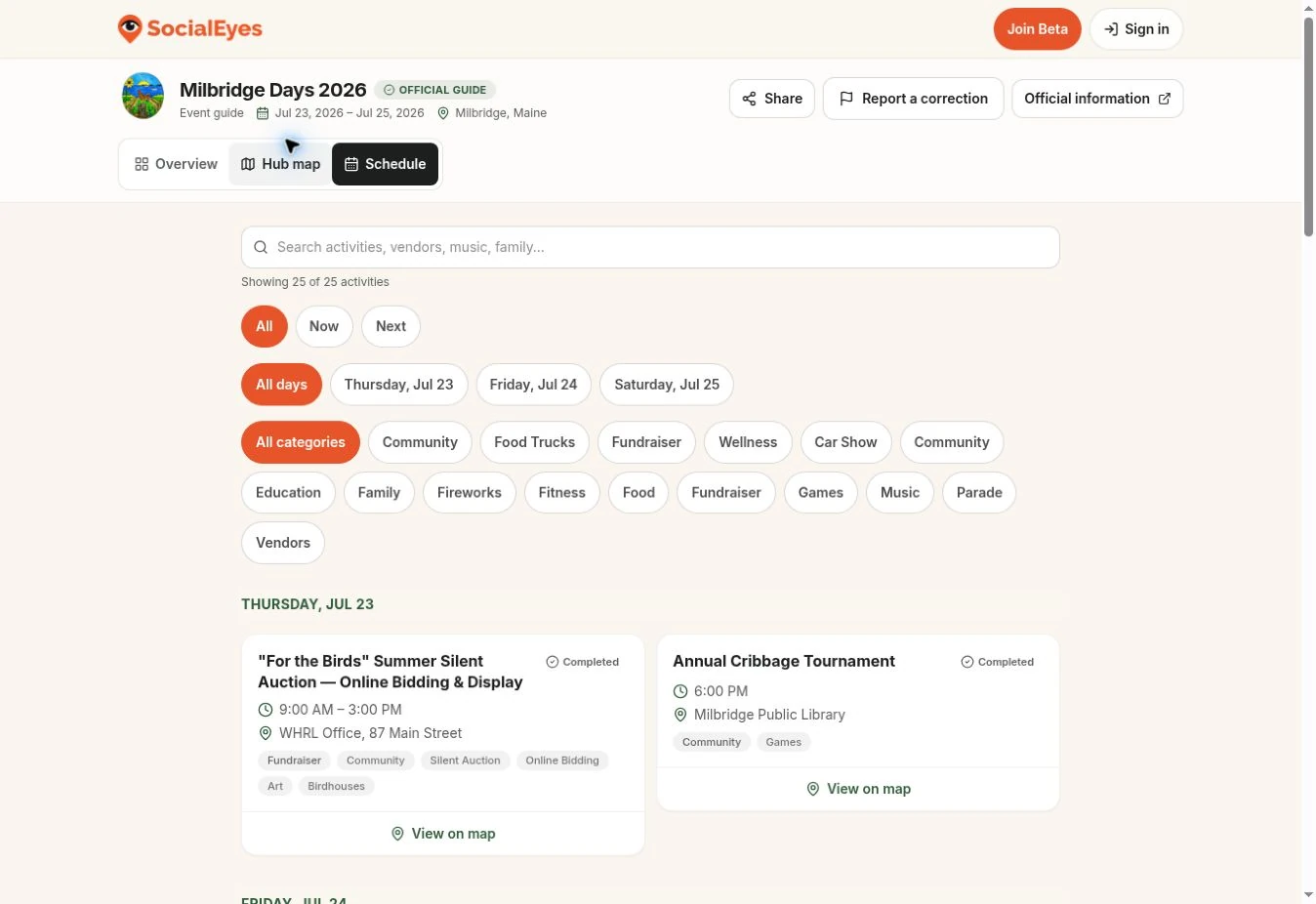
Public Hubs provide an immediate answer to “What can I do here?” At Milbridge Days, organizers adopted a SocialEyes guide as their official interactive map and schedule. People could browse without an account. Personal profiles are not shown to anonymous Hub visitors.
Peace Love & Vans tested another entry point: a shared event layer in an independent activation, not the official event app.
The first-party reports define the observed activity and its limits. Visits, views, and sharing actions help guide the next iteration; they do not establish attendance, new relationships, or reduced loneliness.
Be discoverable on your terms.
Disclosure before discovery means deciding what a particular viewer may receive before personal information is transmitted. The privacy-first design principle belongs in the service’s decisions as well as the visible controls.
Public guides and intentionally public content still have a place. Browsing a schedule should not itself announce someone’s presence, express an intention to meet, or authorize a personal post.
One event. Separate choices.
- Read the public guide
- Find the concert time without choosing personal discoverability.
- Choose a social context
- Decide which information may be discoverable, to whom, and for how long.
- Approve a personal action
- Review the audience and content before a suggestion becomes your post.
This is intended behavior to design and test; individual capabilities are at different stages.
For AI-assisted actions, permission needs to hold when the action executes. A helpful suggestion remains a proposal until the required approval is present.
Does it make connection easier?
The WHO describes loneliness as a distressing gap between the connection people have and the connection they want. SocialEyes’ mission is to reduce barriers to a first step toward company. Its effect on loneliness remains a research question.
Proposed human-centered studies would ask:
- Does someone find a reason to participate?Observe an activity-finding task and whether the next step feels relevant and welcome.
- Can they predict who will see them?Ask participants to explain the audience and information before confirming a choice.
- Can they change their mind?Observe whether they understand how to stop sharing or withdraw an approval.
Early studies could use prototypes and fictional profiles, recording task completion, audience misunderstandings, and why people stop or continue. The Consent & Authority Lab separately tests permission rules through synthetic fixtures, with no live model calls.
A design direction with a documented history.
Scott LaForge filed five U.S. provisional patent applications related to SocialEyes in April 2026. These are founder-held filings. Their high-level themes include selective disclosure, interaction control, useful context, and present intent.
Provisional applications are not issued patents. The filings provide historical context for the design questions; they are not evaluation evidence. The Lab does not establish patent scope or validate patent claims.
From social graph to social utility.
A social graph describes people and their relationships. SocialEyes’ broader conceptual model adds places, activities, time, interests, present intent, current availability, and permission. The product question becomes: which opportunity makes sense now, and what may each person discover?
The utility is what someone can do with that context: find an event, choose an activity, coordinate around it, and decide whether to connect. Hubs give organizers a practical guide to share and give more people a common reason to arrive. They support the social mission by making the product useful before someone has built a network there.
The web app beta and deployed public Hub pilots are available to explore. Full self-service authoring, private Hub capabilities, and expanded groups remain in development.
Sources and further reading
First-party field reports support the deployment facts. The interpretation and proposed research are ExpansionFlow’s; the filing history is founder-reported.
See the work behind the story.
Product decisions, real interfaces, and learning from community pilots.